David Carmichael
david@knowyourdrugs.org

My family was destroyed by the SSRI (selective serotonin reuptake inhibitor) antidepressant Paxil.
I first started taking Paxil in July 2003 to help me deal with cash flow worries after being told that I had a chemical imbalance in my brain that could only be corrected by an SSRI, which is a false claim created by pharmaceutical companies to influence people to take SSRIs, including those dealing with normal mental health challenges (e.g., sadness/anxiety of everyday life). My doctor also didn’t obtain informed consent, which is a legal requirement that includes making patients aware of any serious side effects of a drug and alternative treatment options before the drug is prescribed.
In July 2004, shortly after I started taking Paxil again for anxiety caused by sleep deprivation, after being off it for four months, I had a psychotic episode (rare side effect of Paxil) and planned, appeared normal and then calmly took the life of my 11-year-old son, Ian, on July 31 in London, Canada and was charged with first-degree murder.
My motivation was based on the symptom of psychosis that I had at the time called delusions (fixed false beliefs). I didn’t have any hallucinations (hearing or seeing things that aren’t there), which is another symptom of psychosis. I was convinced, in my delusional state and being emotionally blunted (common side effect of Paxil), that I needed to break the law and do the right thing morally, which I knew meant sacrificing my future by spending the next 25 years in prison.
I thought taking Ian’s life was morally right because of these five delusions, which made no sense to me when I was no longer psychotic two weeks after I was arrested and immediately taken off Paxil:
- Ian had permanent brain damage because he had been diagnosed with mild epilepsy, which I was never concerned about when I wasn’t delusional or I wouldn’t have encouraged him to try difficult tricks on his BMX. He only ever had one seizure and it wasn’t a grand mal. Autopsy results from the London police showed there was nothing wrong with Ian’s brain.
- Ian was in a living hell because he was teased every so often by other children because he was behind academically. This was never a concern of mine when I wasn’t delusional. Ian was born in December, which are the youngest children in their classrooms in Canadian schools, so I expected him to be developmentally behind many of the other students.
- Ian was going to kill his sister Gillian because they were arguing. Gillian was 14 years old at the time and when I wasn’t delusional, I wasn’t concerned about what was simply normal sibling interactive behaviour.
- My wife was going to have a nervous breakdown caring for Ian because of what I thought, in my delusional state, was his permanent brain damage and being in a living hell.
- Ian was going to hurt other children because a few days before I took his life he pushed a child into the swimming pool at a summer day camp in Toronto that I was directing.
I was judged not criminally responsible (insane when I took Ian’s life) in September 2005 based on a joint resolution between my defense lawyer and the crown attorney (prosecutor). The joint resolution was based on the same diagnosis from both the forensic psychiatrist hired by my lawyer and the forensic psychiatrist hired by the crown attorney that I was suffering from “major depression with psychotic episodes” at the time of my homicide.
In October 2005, I was sent to Brockville Mental Health Centre (forensic psychiatric hospital). I received a conditional discharge from the Ontario Review Board in December 2008, which allowed me to live with my wife and daughter again, and an absolute discharge in December 2009. I’ve been off psychiatric drugs since September 2010.
Paxil was not discussed at my criminal trial. Even though there was evidence before my trial that Paxil caused my psychosis, my lawyer told me how difficult it would be to prove causation, and even if we were successful at proving that Paxil probably caused my homicidal psychotic episode, the best I could expect was a manslaughter conviction since prescription drugs were in the same intoxication section of the Criminal Code of Canada as illicit drugs.
I saw more than a dozen psychiatrists between August 2004 and December 2009, when I received my absolute discharge, and none of them disputed that Paxil might have caused my homicidal psychotic episode. They were all aware of the June 2004 Health Canada warning about SSRI antidepressants that “patients of all ages taking these drugs may experience behavioural and/or emotional changes that may put them at increased risk of self-harm or harm to others.”
The details of my experiences with Paxil are on pages 12 to 15 in my chronology, which I put together in 2024 to help validate that I had no history of mental illness before I started taking Paxil and that I haven’t had a mental illness since I was taken off Paxil in the London police station on July 31, 2004, which supports the argument that Paxil caused my homicidal psychotic episode and not a genetically-based mental illness.
I’ve also provided insight into my behaviour on Paxil and homicidal psychotic episode in this 9-minute opening segment of a 60-minute podcast interview in 2025 with Dr. Josef Witt-Doerring, a psychiatrist and former medical officer in the psychiatry division at the FDA (Food and Drug Administration) in the United States, who has also worked at pharmaceutical companies in clinical research and drug safety positions.
Before July 2004, I had successful career in the physical activity and sport sector after graduating in 1985 from York University in Toronto, Canada with a master’s degree in physical education with a specialization in the physiology and psychology of coaching. I was development officer at the Western Australian Amateur Wrestling Association (WrestlingWA) from 1985 to 1987, high performance director at the Ontario Amateur Wrestling Association (OAWA) from 1998 to 1991, director of research and development at the Ontario Physical and Health Education Association (OPHEA) from 1989 to 1998, and director of national projects at ParticipACTION from 1998 to 2001. I also developed a multiskill development program for children called Sportability from 1986 to 1990, and was a course conductor on long-term athlete development for the Coaching Association of Canada from 1999 to 2004.
After I was discharged from the mental health centre in 2009, I built a career as a prescription drug safety advocate. I was media relations officer at RxISK.org from 2012 to 2014, executive director at People’s Right to Integrative Medicine in 2014 and 2015, and I founded and was executive director of Canadians for Vanessa’s Law (Protecting Canadians from Unsafe Drugs Act) from 2015 to 2023. I developed Know Your Drugs in 2017 and the 40-minute presentation How SSRI Antidepressants Cause Suicide, Homicide and Mass Shootings in 2025.
In 2011, I filed a lawsuit against GlaxoSmithKline (GSK), the manufacturer of Paxil, claiming that they fraudulently concealed clinical trial data about suicidal and homicidal side effects, which prevented me from making an informed choice about use. My lawsuit was ultimately dismissed in 2021 by the Supreme Court of Canada based on a statute of limitations motion filed by GSK in 2017, so I wasn’t able to put Paxil on Trial.
In 2025, I merged my two careers and developed Sport for Mental Health as an information portal for coaches who would like to help athletes build their self-esteem and develop mental skills, which would help prevent the overprescribing of psychiatric drugs. It includes a presentation I delivered on long-term athlete development that was filmed by a Toronto television station in 1990 and a 2025 program example with no copyright restrictions called Sportstart.
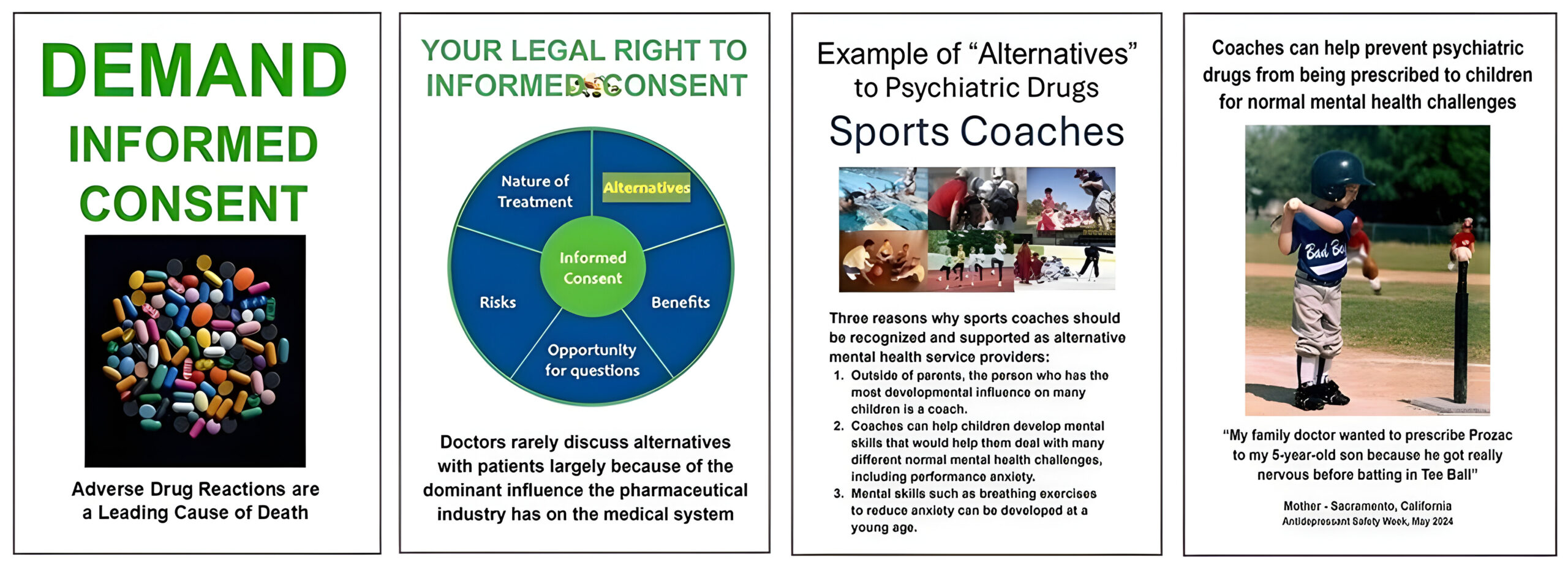
I’m starting an SSRI Around-America Tour in Houston, Texas on April 18, 2026 that will evolve without an end date, and I’ve started delivering the 15-minute talk DEMAND INFORMED CONSENT: It’s Your Legal Right to groups of any size on their online meeting platforms. My talk raises awareness of the legal requirement for doctors to discuss alternative treatment options with patients to obtain informed consent before prescribing a drug. Some of the reasons why this rarely happens are explained on the Champions for Change page at Know Your Drugs.


 David Carmichael

